MAT147 Applied Calculus
Review Set 2
Question 1
A line passes through the points \((-3, 5)\) and \((2, 1)\text{.}\) Find the slope \(m\) and the \(x\)-intercept of the line.
Solution 1
\begin{align*} m \amp= \frac{1 - 5}{2 - (-3)}\\ \amp= \frac{-4}{5} \end{align*}Using point-slope form with \((2,1)\text{:}\)
\begin{align*} y - 1 \amp= -\frac{4}{5}(x - 2) \end{align*}Set \(y = 0\) to find the \(x\)-intercept:
\begin{align*} -1 \amp= -\frac{4}{5}(x - 2)\\ \frac{5}{4} \amp= x - 2\\ x \amp= \frac{13}{4} \end{align*}So \(m = -\frac{4}{5}\) and the \(x\)-intercept is \(\left(\frac{13}{4}, 0\right)\text{.}\)
Question 2
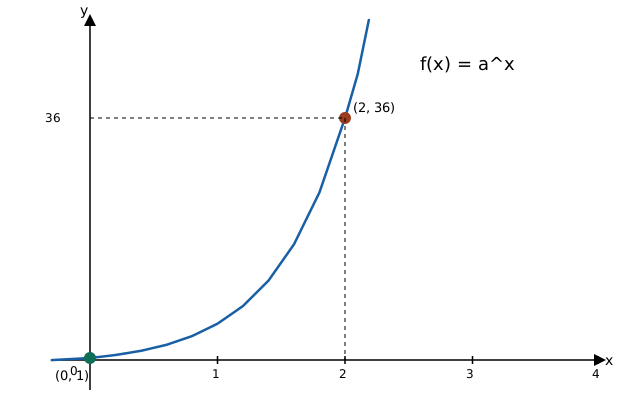
The graph below shows \(f(x) = a^x\text{,}\) passing through the points \((0, 1)\) and \((2, 36)\text{.}\) Find \(\log_a(36)\text{.}\)
Solution 2
Since \(f(2) = a^2 = 36\text{,}\) the equation \(a^2 = 36\) converts directly to logarithmic form:
\begin{align*} \log_a(36) \amp= 2 \end{align*}No need to solve for \(a\) itself — the exponent in \(a^2 = 36\) is already the answer to \(\log_a(36)\text{.}\)
Question 3
A skydiver’s velocity \(t\) seconds after jumping is given by \(v(t) = 80(1 - e^{-0.1t})\text{.}\) After how many seconds is the velocity \(90\) ft/s?
Solution 3
As \(t \to \infty\text{,}\) \(e^{-0.1t} \to 0\text{,}\) so \(v(t) \to 80(1 - 0) = 80\text{.}\)
The value \(80\) ft/s is a horizontal asymptote — the skydiver’s terminal velocity. Since \(90 > 80\text{,}\) the velocity never reaches \(90\) ft/s.
There is no such \(t\text{.}\)
Question 4
Let \(f(x) = 3x + 5\text{.}\) Compute the difference quotient \(\dfrac{f(x+h) - f(x)}{h}\text{.}\)
Solution 4
\begin{align*} f(x+h) \amp= 3(x+h) + 5 = 3x + 3h + 5\\ f(x+h) - f(x) \amp= (3x + 3h + 5) - (3x + 5) = 3h\\ \frac{f(x+h) - f(x)}{h} \amp= \frac{3h}{h} = 3 \end{align*}The difference quotient equals \(3\text{,}\) the slope of the line — as expected, since a linear function has constant slope.
Question 5
Let \(f(x) = x^2 - 4\text{.}\) Compute the difference quotient \(\dfrac{f(x+h) - f(x)}{h}\text{.}\)
Solution 5
\begin{align*} f(x+h) \amp= (x+h)^2 - 4 = x^2 + 2xh + h^2 - 4\\ f(x+h) - f(x) \amp= (x^2 + 2xh + h^2 - 4) - (x^2 - 4) = 2xh + h^2\\ \frac{f(x+h) - f(x)}{h} \amp= \frac{h(2x + h)}{h} = 2x + h \end{align*}The difference quotient is \(2x + h\text{,}\) which depends on \(x\) — unlike the linear case.
Question 6
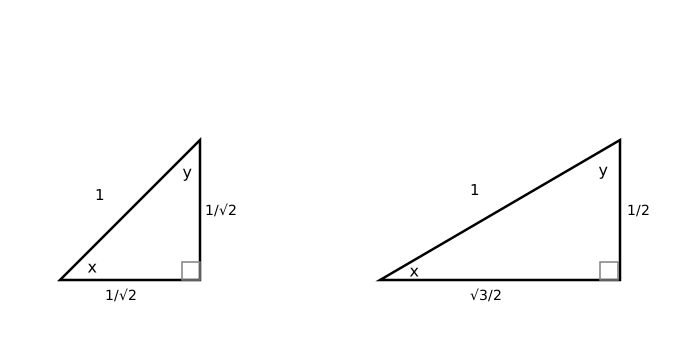
For each triangle below, find the angles \(x\) and \(y\text{.}\)
Solution 6
Left triangle: both legs equal \(\frac{1}{\sqrt{2}}\text{,}\) so it is an isosceles right triangle. The two acute angles are equal and must sum to \(90^\circ\text{,}\) so \(x = y = 45^\circ\text{.}\)
Right triangle: with hypotenuse \(1\text{,}\) the side \(\frac12\) opposite \(x\) and side \(\frac{\sqrt3}{2}\) opposite \(y\) match the standard \(30\text{-}60\text{-}90\) ratios, so \(x = 30^\circ\) and \(y = 60^\circ\text{.}\)
Question 7
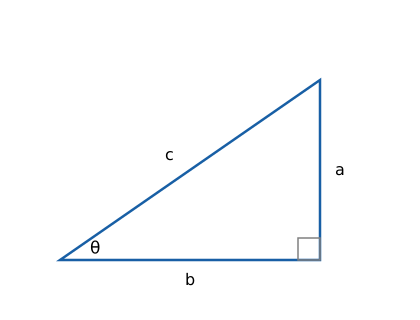
In the right triangle below, the legs and hypotenuse are labeled \(a\text{,}\) \(b\text{,}\) and \(c\text{,}\) with acute angle \(\theta\) as shown. Find \(\sin(\theta)\text{,}\) \(\cos(\theta)\text{,}\) and \(\tan(\theta)\) in terms of \(a\text{,}\) \(b\text{,}\) and \(c\text{.}\)
Solution 7
Relative to \(\theta\text{:}\) side \(a\) is opposite, side \(b\) is adjacent, and \(c\) is the hypotenuse.
\begin{align*} \sin(\theta) \amp= \frac{a}{c}\\ \cos(\theta) \amp= \frac{b}{c}\\ \tan(\theta) \amp= \frac{a}{b} \end{align*}
Question 8
Suppose \(f(t) = Q_0(1+r)^t\) with \(f(2) = 16 Q_0\text{.}\) Find \(r\text{.}\)
Solution 8
\begin{align*} Q_0(1+r)^2 \amp= 16 Q_0\\ (1+r)^2 \amp= 16\\ 1 + r \amp= 4\\ r \amp= 3 \end{align*}(Taking the positive root, since \(1 + r > 0\) for a growth model.)
Question 9
Evaluate \(\sin(30^\circ)\text{,}\) \(\cos(30^\circ)\text{,}\) \(\sin(60^\circ)\text{,}\) and \(\cos(60^\circ)\text{.}\)
Solution 9
\begin{align*} \sin(30^\circ) \amp= \frac{1}{2}\\ \cos(30^\circ) \amp= \frac{\sqrt3}{2}\\ \sin(60^\circ) \amp= \frac{\sqrt3}{2}\\ \cos(60^\circ) \amp= \frac{1}{2} \end{align*}Note that \(\sin(30^\circ) = \cos(60^\circ)\) and \(\cos(30^\circ) = \sin(60^\circ)\) — these angles are complementary.