Week 2 — Review Questions
Reading derivatives from graphs, tangent lines, and difference quotients
Question 1 — Sketch the Derivative
Carefully sketch the derivative function of \(f(x)\) shown (estimate values at several \(x\) as you go). Use your derivative sketch to estimate:
- \(f'(-3) =\) ____
- \(f'(-1) =\) ____
- \(f'(1) =\) ____
- \(f'(3) =\) ____
![A curve on the interval [-4,4] that decreases steeply from the top left, flattens into a shallow shelf between about x=-2 and x=0, continues down to a minimum near x=2, then rises steeply to the top right near x=4.](external/images/problem11_graph.svg)
Solution 1
Reading the steepness and direction of the tangent line at each marked \(x\)-value:
(a) At \(x=-3\) the curve is falling steeply, so \(f'(-3)\) is a large negative number, roughly \(f'(-3) \approx -3\text{.}\)
(b) At \(x=-1\) the curve is on the shallow flat shelf, so the tangent line is nearly horizontal: \(f'(-1) \approx 0\text{.}\)
(c) At \(x=1\) the curve is still gently decreasing on its way down to the minimum, so \(f'(1) \approx -1\) (negative, but less steep than at \(x=-3\)).
(d) At \(x=3\) the curve is climbing very steeply out of the minimum, so \(f'(3)\) is a large positive number, roughly \(f'(3) \approx 5\text{.}\)
(Exact values will vary slightly from student to student — what matters is the sign and relative size of each estimate.)
Question 2 — Compare Using the Graph
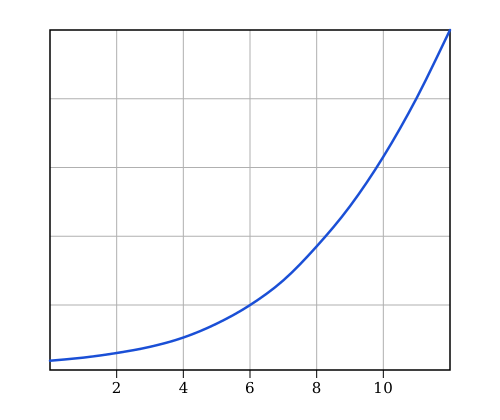
Consider the graph of \(f(x)\) shown. For each part, give the relationship between the two quantities: \(\lt\text{,}\) \(=\text{,}\) \(\gt\text{,}\) or unclear.
- \(f(6)\) ____ \(f(8)\)
- \(f(6) - f(4)\) ____ \(f(4) - f(2)\)
- \(\dfrac{f(4)-f(2)}{4-2}\) ____ \(\dfrac{f(6)-f(2)}{6-2}\)
- \(f'(2)\) ____ \(f'(8)\)
Solution 2
\(f\) is increasing and convex (bends upward), so its slope is increasing and its rate of growth speeds up to the right.
(a) Since \(f\) is increasing, \(f(6) \lt f(8)\text{.}\)
(b) Because \(f\) is convex, equal-width intervals farther to the right show a bigger change, so \(f(6) - f(4) \gt f(4) - f(2)\text{.}\)
(c) The secant slope over a longer interval starting at the same point picks up the steeper right-hand part of the curve, so \(\dfrac{f(4)-f(2)}{4-2} \lt \dfrac{f(6)-f(2)}{6-2}\text{.}\)
(d) Since the curve gets steeper as \(x\) increases, \(f'(2) \lt f'(8)\text{.}\)
Question 3 — Least and Greatest Values
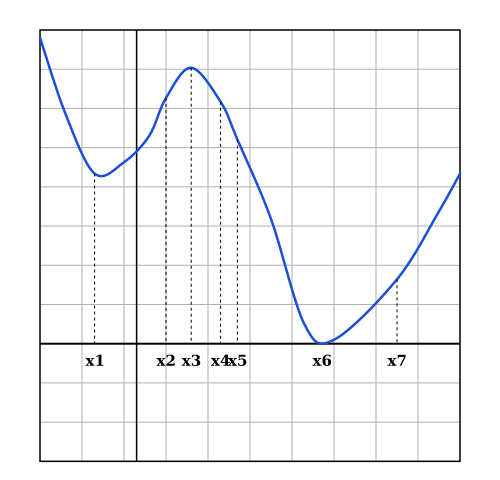
The graph of a function \(f'(x)\) is shown. At which of the labeled \(x\)-values is:
- \(f(x)\) least? \(x =\) ____
- \(f(x)\) greatest? \(x =\) ____
- \(f'(x)\) least? \(x =\) ____
- \(f'(x)\) greatest? \(x =\) ____
Solution 3
The graph shown is \(f'(x)\text{,}\) not \(f(x)\) itself — so parts (a)/(b) and parts (c)/(d) need two different kinds of reasoning.
(a), (b) Notice the graph of \(f'(x)\) never dips below the axis — it only touches \(0\) briefly at \(x_6\) and is positive everywhere else. Since \(f'(x) \ge 0\) throughout, \(f\) is non-decreasing over the whole picture. For a non-decreasing function, the smallest labeled \(x\)-value gives the smallest output and the largest labeled \(x\)-value gives the largest output. So \(f(x)\) is least at \(x = x_1\) (the leftmost label) and greatest at \(x = x_7\) (the rightmost label).
(c), (d) Now we read the graph directly, since it is \(f'(x)\text{.}\) The lowest point on the graph among the labeled values is where it dips to touch \(0\) at \(x_6\text{,}\) so \(f'(x)\) is least at \(x = x_6\). The highest point is the peak of the hump at \(x_3\text{,}\) so \(f'(x)\) is greatest at \(x = x_3\).
Question 4 — Evaluating \(g(x)\) from a Graph
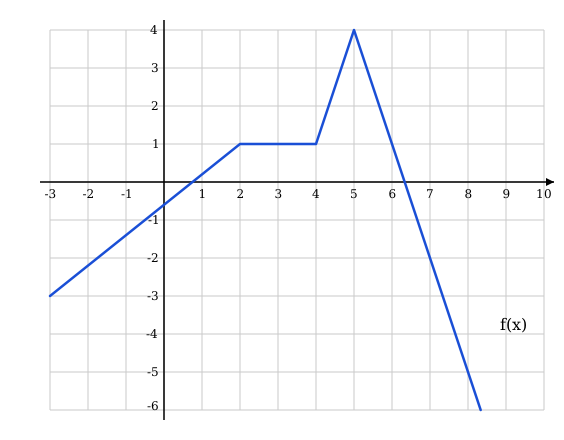
Let \(g(x) = \displaystyle\lim_{h \to 0} \dfrac{f(x+h) - f(x)}{h}\text{,}\) where \(f(x)\) is the piecewise linear function shown. Find:
- \(\displaystyle g(0)\)
- \(\displaystyle g(3)\)
- \(\displaystyle g(5)\)
- \(\displaystyle g(8)\)
Solution 4
\(g(x) = f'(x)\text{.}\) Since \(f\) is piecewise linear, \(f'\) is constant on each linear piece and undefined at the corners.
(a) \(x=0\) lies on the segment from \((-3,-3)\) to \((2,1)\text{,}\) with slope \(\dfrac{1-(-3)}{2-(-3)} = \dfrac{4}{5}\text{.}\) So \(g(0) = \dfrac{4}{5}\text{.}\)
(b) \(x=3\) lies on the flat segment from \((2,1)\) to \((4,1)\text{,}\) which has slope \(0\text{.}\) So \(g(3) = 0\text{.}\)
(c) \(x=5\) is the corner where the rising segment (slope \(3\)) meets the falling segment (slope \(\approx -3\)). Since the left- and right-hand slopes disagree, \(f'(5)\) does not exist, so \(g(5)\) does not exist.
(d) \(x=8\) lies on the falling segment from \((5,4)\) to about \((8.3,-6)\text{,}\) with slope \(\dfrac{-6-4}{8.3-5} \approx -3\text{.}\) So \(g(8) \approx -3\text{.}\)
Question 5 — Estimating with the Derivative
Suppose that \(f(x)\) is a function with \(f(90) = 58\) and \(f'(90) = 3\text{.}\)
Estimate \(f(93.5)\text{.}\)
Solution 5
Use the tangent line (linear) approximation at \(x=90\text{:}\)
\begin{equation*} f(93.5) \approx f(90) + f'(90)\,(93.5 - 90) \end{equation*}\begin{equation*} f(93.5) \approx 58 + 3(3.5) = 58 + 10.5 = 68.5 \end{equation*}
Question 6 — Difference Quotient
Let \(f(x) = 2 + 6x^2\text{.}\) If \(h \neq 0\text{,}\) then the difference quotient can be simplified as
where \(A\text{,}\) \(B\text{,}\) and \(C\) are constants.
- Find the constants \(A\text{,}\) \(B\text{,}\) and \(C\text{.}\)
- Use the simplified expression to find \(f'(x) = \displaystyle\lim_{h \to 0} \dfrac{f(x+h) - f(x)}{h}\text{.}\)
Solution 6
\begin{equation*} f(x+h) = 2 + 6(x+h)^2 = 2 + 6x^2 + 12xh + 6h^2 \end{equation*}\begin{equation*} f(x+h) - f(x) = 12xh + 6h^2 \end{equation*}\begin{equation*} \dfrac{f(x+h)-f(x)}{h} = 12x + 6h = 6h + 12x + 0 \end{equation*}(a) Matching to \(Ah + Bx + C\text{:}\) \(A = 6\text{,}\) \(B = 12\text{,}\) \(C = 0\text{.}\)
(b) Taking \(h \to 0\text{:}\)
\begin{equation*} f'(x) = 12x \end{equation*}
Question 7 — Sketch \(f(x)\) from Information about \(f'(x)\)
Given:
- \(f'(x) \gt 0\) if \(x \lt -3\)
- \(f'(x) \lt 0\) if \(-3 \lt x \lt 3\)
- \(f'(x) \gt 0\) if \(x \gt 3\)
- \(\displaystyle |f(x)| \lt 6\)
Use the information provided to sketch a possible graph of \(f(x)\text{.}\)
Solution 7
The sign of \(f'\) tells us where \(f\) is increasing or decreasing:
\(f\) is increasing on \((-\infty, -3)\text{,}\) reaches a local maximum at \(x=-3\), then is decreasing on \((-3, 3)\text{,}\) reaches a local minimum at \(x=3\), then is increasing again on \((3, \infty)\text{.}\)
The condition \(|f(x)| \lt 6\) means the whole graph must stay strictly between the horizontal lines \(y=6\) and \(y=-6\) — so a valid sketch rises toward (but never reaches) some value below \(6\) at \(x=-3\text{,}\) dips toward (but never reaches) some value above \(-6\) at \(x=3\text{,}\) and continues to rise afterward while staying under \(y=6\text{.}\)
Question 8 — Tangent Line and Rate of Change
Suppose that \(f(x) = 2x^2 - 8x\text{.}\)
- Find the equation of the line tangent to \(f(x)\) at \(x = 2\text{.}\) \(y =\) ____
Solution 8
The slope of the tangent line at \(x=2\) is \(f'(2)\text{.}\) Differentiating,
\begin{equation*} f'(x) = 4x - 8 \end{equation*}\begin{equation*} f'(2) = 4(2) - 8 = 0 \end{equation*}The slope is \(0\text{,}\) so the tangent line is horizontal. The point of tangency is \(f(2) = 2(4) - 8(2) = 8 - 16 = -8\text{,}\) so the point is \((2, -8)\text{.}\) A horizontal line through \((2,-8)\) is simply:
\begin{equation*} y = -8 \end{equation*}
Question 9 — Instantaneous Velocity
The displacement (in meters) of a particle moving in a straight line is given by
where \(t\) is measured in seconds. Find the instantaneous velocity when \(t = 4\text{.}\)
Solution 9
The instantaneous velocity is \(s'(t)\text{.}\) Differentiating,
\begin{equation*} s'(t) = 2t - 5 \end{equation*}So at \(t=4\text{,}\)
\begin{equation*} s'(4) = 2(4) - 5 = 3 \text{ m/s} \end{equation*}