Week 3 — Review Questions
Units, rates of change, reading graphs of derivatives, tangent lines, and differentiability
Question 1 — Interpreting an Inverse
Let \(V = f(t)\) be the number of liters of water in a tank \(t\) minutes after it starts draining.
Explain what \(f^{-1}(50) = 8\) means in context.
Solution 1
The inverse function \(f^{-1}\) takes an amount of water (in liters) as input and gives a time (in minutes) as output.
So \(f^{-1}(50) = 8\) means that 8 minutes after the tank starts draining, it contains 50 liters of water. Equivalently, \(f(8) = 50\text{.}\)
Question 2 — Average Velocity
A particle’s position is given by
where \(s\) is in meters and \(t\) is in seconds. Find the average velocity on the interval \([2, 3]\text{.}\)
Solution 2
Average velocity is the change in position divided by the change in time:
\begin{equation*} s(3) = 9 + 12 = 21, \qquad s(2) = 4 + 8 = 12 \end{equation*}\begin{equation*} \dfrac{s(3) - s(2)}{3 - 2} = \dfrac{21 - 12}{1} = 9 \text{ m/s} \end{equation*}
Question 3 — Signs of \(P'\) and \(P''\)
Let \(P(t)\) be the population of a town at time \(t\text{.}\) For each statement, give the signs of \(P'(t)\) and \(P''(t)\text{.}\)
- The population is growing, but more and more slowly.
- The population is decreasing faster and faster.
Solution 3
\(P'\) tells whether the population is growing or shrinking. \(P''\) tells whether that rate is increasing or decreasing.
(a) Growing means \(P'(t) \gt 0\text{.}\) Growing more slowly means the rate is decreasing, so \(P''(t) \lt 0\text{.}\)
(b) Decreasing means \(P'(t) \lt 0\text{.}\) Decreasing faster and faster means the rate is becoming more negative, so \(P''(t) \lt 0\text{.}\)
Question 4 — Reading a Graph of \(f'(x)\)
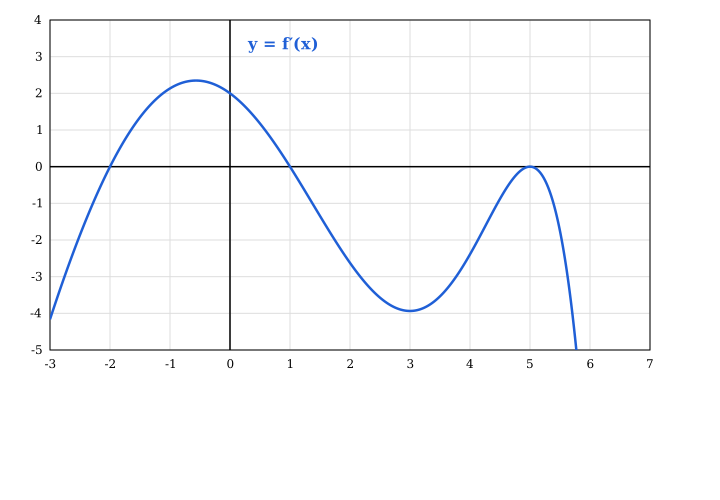
The graph of \(f'(x)\) (not \(f(x)\)) is shown.
- Where does \(f\) have a local maximum?
- Where is \(f''(x) = 0\text{?}\)
Solution 4
The graph shown is \(f'(x)\text{,}\) so its sign tells where \(f\) increases or decreases, and its slope is \(f''(x)\text{.}\)
(a) \(f\) has a local maximum where \(f'\) changes from positive to negative. That happens only at \(x = 1\). At \(x = 5\text{,}\) \(f'\) touches zero but stays negative on both sides, so \(f\) has no local extremum there.
(b) \(f''(x) = 0\) where the graph of \(f'\) has a horizontal tangent line, at its peaks and valleys: \(x \approx -0.57\text{,}\) \(x = 3\text{,}\) and \(x = 5\).
Question 5 — Matching \(f\text{,}\) \(f'\text{,}\) and \(f''\)
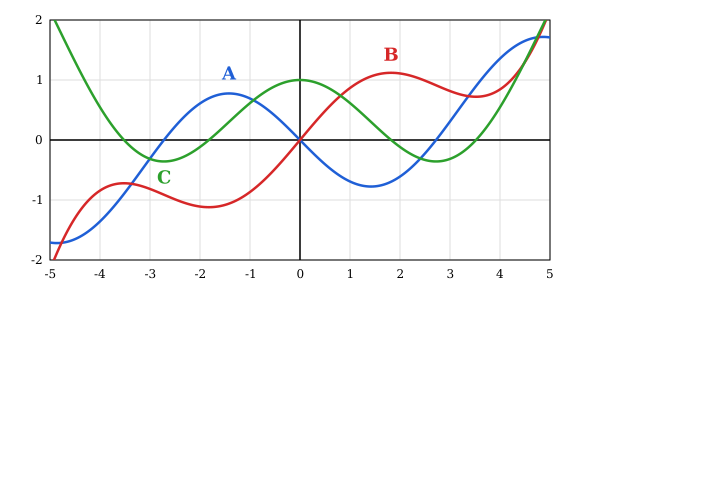
Graphs A, B, and C show \(f(x)\text{,}\) \(f'(x)\text{,}\) and \(f''(x)\text{.}\) Identify which graph is which, and give a reason.
- \(f(x)\) is graph ____
- \(f'(x)\) is graph ____
- \(f''(x)\) is graph ____
Solution 5
A derivative is zero wherever the original function has a peak or valley.
Graph B has peaks and valleys at \(x \approx \pm 1.8\) and \(x \approx \pm 3.5\text{,}\) and graph C crosses zero at exactly those points. So C is the derivative of B.
Graph C has its lowest points at \(x \approx \pm 2.7\text{,}\) and graph A crosses zero at exactly those points. So A is the derivative of C.
(a) \(f(x)\) is graph B. (b) \(f'(x)\) is graph C. (c) \(f''(x)\) is graph A.
Question 6 — Average Acceleration from a Table
A car’s velocity is given in the table below.
| \(t\) (s) | 0 | 1 | 2 | 3 |
| \(v(t)\) (ft/s) | 0 | 22 | 38 | 50 |
Find the average acceleration over the first second and over the second second. Include units.
Solution 6
Average acceleration is the change in velocity divided by the change in time.
First second (\(t = 0\) to \(t = 1\)):
\begin{equation*} \dfrac{v(1) - v(0)}{1 - 0} = \dfrac{22 - 0}{1} = 22 \text{ ft/s}^2 \end{equation*}Second second (\(t = 1\) to \(t = 2\)):
\begin{equation*} \dfrac{v(2) - v(1)}{2 - 1} = \dfrac{38 - 22}{1} = 16 \text{ ft/s}^2 \end{equation*}
Question 7 — Slope of a Tangent Line
The tangent line to \(y = f(x)\) at the point \((2, 5)\) passes through the point \((6, 17)\text{.}\)
Find \(f'(2)\text{.}\)
Solution 7
\(f'(2)\) is the slope of the tangent line at \(x = 2\text{.}\) The line passes through \((2, 5)\) and \((6, 17)\text{,}\) so
\begin{equation*} f'(2) = \dfrac{17 - 5}{6 - 2} = \dfrac{12}{4} = 3 \end{equation*}
Question 8 — Differentiability
Let
Find all \(x\) where \(f(x)\) is not differentiable, and explain why.
Solution 8
The expression inside the absolute value is zero when \(4x - 12 = 0\text{,}\) so at \(x = 3\text{.}\)
For \(x \lt 3\text{,}\) \(f(x) = -(4x - 12)\text{,}\) which has slope \(-4\text{.}\) For \(x \gt 3\text{,}\) \(f(x) = 4x - 12\text{,}\) which has slope \(4\text{.}\)
The left- and right-hand slopes disagree, so the graph has a sharp corner at \(x = 3\text{.}\) Therefore \(f\) is not differentiable at \(x = 3\).