Week 5 — Review Questions (Part 2)
Exponential and trig derivatives, the product rule, and the quotient rule
Question 1 — Exponential Plus a Power
Find the derivative of
Solution 1
The derivative of \(e^x\) is \(e^x\text{,}\) and the power rule handles \(x^6\text{:}\)
\begin{equation*} f'(x) = 13e^x + 6x^5 \end{equation*}
Question 2 — Exponential vs. Power
Find the derivative of
where \(d\) is a positive constant.
Solution 2
\(d^x\) is an exponential function (variable in the exponent), while \(x^d\) is a power function (constant exponent):
\begin{equation*} \dfrac{d}{dx}\left[d^x\right] = d^x \ln d \qquad \dfrac{d}{dx}\left[x^d\right] = d\,x^{d-1} \end{equation*}\begin{equation*} y'(x) = d^x \ln d + d\,x^{d-1} \end{equation*}
Question 3 — Rate of Population Change
Since January 1, 1960, the population of Slim Chance has been described by
where \(t\) is years after the start of 1960. At what rate was the population changing on January 1, 1985?
Solution 3
Differentiate using \(\frac{d}{dt}\left[a^t\right] = a^t \ln a\text{:}\)
\begin{equation*} P'(t) = 36000(0.9)^t \ln(0.9) \end{equation*}January 1, 1985 is \(t = 25\text{:}\)
\begin{equation*} P'(25) = 36000(0.9)^{25}\ln(0.9) \approx -272.3 \text{ people/yr} \end{equation*}The population was decreasing by about 272 people per year.
Question 4 — Tangent and Normal Lines
Consider \(f(x) = 8 - e^x\text{.}\)
- Find the slope of the graph of \(f\) at the point where the graph crosses the \(x\)-axis.
- Find the equation of the tangent line at this point.
- Find the equation of the normal line (perpendicular to the tangent line) at this point.
Solution 4
\(f(x) = 0\) when \(e^x = 8\text{,}\) so \(x = \ln 8\text{.}\) Since \(f'(x) = -e^x\text{,}\)
\begin{equation*} \text{A.}\quad f'(\ln 8) = -e^{\ln 8} = -8 \end{equation*}\begin{equation*} \text{B.}\quad y = -8(x - \ln 8) = -8x + 8\ln 8 \end{equation*}The normal slope is the negative reciprocal, \(\frac{1}{8}\text{:}\)
\begin{equation*} \text{C.}\quad y = \dfrac{1}{8}(x - \ln 8) = \dfrac{1}{8}x - \dfrac{\ln 8}{8} \end{equation*}
Question 5 — Product Rule with an Exponential
Find the derivative of
Solution 5
Rewrite \(\sqrt[5]{x} = x^{1/5}\) and use the product rule \((uv)' = u'v + uv'\text{:}\)
\begin{equation*} u = x^6 - x^{1/5}, \quad u' = 6x^5 - \dfrac{1}{5}x^{-4/5} \qquad v = 4^x, \quad v' = 4^x \ln 4 \end{equation*}\begin{equation*} f'(x) = \left(6x^5 - \dfrac{1}{5}x^{-4/5}\right)4^x + \left(x^6 - x^{1/5}\right)4^x \ln 4 \end{equation*}
Question 6 — Quotient Rule
Find the derivative of
Solution 6
Quotient rule, \(\left(\frac{u}{v}\right)' = \frac{u'v - uv'}{v^2}\text{:}\)
\begin{equation*} \dfrac{dz}{dt} = \dfrac{9(4t + 4) - (9t + 1)(4)}{(4t + 4)^2} = \dfrac{36t + 36 - 36t - 4}{(4t + 4)^2} \end{equation*}\begin{equation*} \dfrac{dz}{dt} = \dfrac{32}{(4t + 4)^2} = \dfrac{2}{(t + 1)^2} \end{equation*}
Question 7 — Product and Quotient Rules from Values
Let
- If \(G(z) = F(z) \cdot H(z)\text{,}\) find \(G'(2)\text{.}\)
- If \(G(w) = F(w) / H(w)\text{,}\) find \(G'(2)\text{.}\)
Solution 7
\begin{equation*} \text{A.}\quad G'(2) = F'(2)H(2) + F(2)H'(2) = 3(5) + 5(3) = 30 \end{equation*}\begin{equation*} \text{B.}\quad G'(2) = \dfrac{F'(2)H(2) - F(2)H'(2)}{H(2)^2} = \dfrac{15 - 15}{25} = 0 \end{equation*}
Question 8 — Product Rule from a Graph
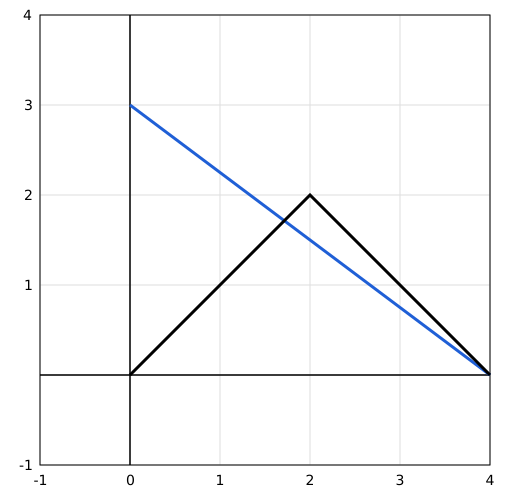
The graph of \(f(x)\) is black and has a sharp corner at \(x = 2\text{.}\) The graph of \(g(x)\) is blue.
Let \(h(x) = f(x) \cdot g(x)\text{.}\) Find the following, or state that the derivative does not exist.
- \(\displaystyle h'(1)\)
- \(\displaystyle h'(2)\)
- \(\displaystyle h'(3)\)
Solution 8
From the graph: \(g(x) = 3 - \frac{3}{4}x\text{,}\) so \(g' = -\frac{3}{4}\text{.}\) \(f\) has slope \(1\) on \((0,2)\) and \(-1\) on \((2,4)\text{.}\) Use \(h' = f'g + fg'\text{.}\)
\begin{equation*} \text{A.}\quad h'(1) = (1)\left(\tfrac{9}{4}\right) + (1)\left(-\tfrac{3}{4}\right) = \tfrac{3}{2} \end{equation*}\begin{equation*} \text{B.}\quad h'(2) \text{ does not exist } (f \text{ has a corner at } x = 2) \end{equation*}\begin{equation*} \text{C.}\quad h'(3) = (-1)\left(\tfrac{3}{4}\right) + (1)\left(-\tfrac{3}{4}\right) = -\tfrac{3}{2} \end{equation*}
Question 9 — Product Rule with Trig
Find the derivative of
Solution 9
Product rule on \(t\sin t\text{,}\) and \(\frac{d}{dt}[\cos t] = -\sin t\text{:}\)
\begin{equation*} h'(t) = (1)\sin t + t\cos t - \sin t = t\cos t \end{equation*}
Question 10 — Tangent Line to a Trig Curve
Find the equation of the tangent line to the curve
at the point \(\left(\frac{\pi}{3}, 3\right)\text{.}\) Write your answer in the form \(y = mx + b\text{.}\)
Solution 10
\begin{equation*} y' = 3\sec x \tan x + 6\sin x \end{equation*}At \(x = \frac{\pi}{3}\text{:}\) \(\sec = 2\text{,}\) \(\tan = \sqrt{3}\text{,}\) \(\sin = \frac{\sqrt{3}}{2}\text{.}\)
\begin{equation*} m = 3(2)(\sqrt{3}) + 6\left(\tfrac{\sqrt{3}}{2}\right) = 9\sqrt{3} \end{equation*}\begin{equation*} y - 3 = 9\sqrt{3}\left(x - \tfrac{\pi}{3}\right) \quad\Rightarrow\quad y = 9\sqrt{3}\,x - 3\sqrt{3}\,\pi + 3 \end{equation*}