Week 5 — Chain Rule (Part 2)
More practice with the chain rule
Question 1 — A Power in the Denominator
Differentiate the following function.
Solution 1
Rewrite with a negative exponent:
\begin{equation*} y = \left(x^2 + 4\right)^{-3} \end{equation*}\begin{equation*} \dfrac{dy}{dx} = -3\left(x^2 + 4\right)^{-4}\cdot 2x = -\dfrac{6x}{\left(x^2 + 4\right)^4} \end{equation*}
Question 2 — Tangent of an Exponential
Differentiate the following function.
Solution 2
Outer function \(\tan u\text{,}\) inner function \(u = e^{2x}\text{,}\) which itself needs the chain rule:
\begin{equation*} \dfrac{dy}{dx} = \sec^2\left(e^{2x}\right)\cdot e^{2x}\cdot 2 = 2e^{2x}\sec^2\left(e^{2x}\right) \end{equation*}
Question 3 — Rate of Temperature Change
The temperature (in degrees) \(t\) hours after midnight is modeled by
Find the rate of change of the temperature at \(t = 4\text{.}\)
Solution 3
\begin{equation*} T'(t) = 15\cos\left(\dfrac{\pi t}{12}\right)\cdot\dfrac{\pi}{12} = \dfrac{5\pi}{4}\cos\left(\dfrac{\pi t}{12}\right) \end{equation*}At \(t = 4\text{,}\) \(\cos\left(\frac{\pi}{3}\right) = \frac{1}{2}\text{:}\)
\begin{equation*} T'(4) = \dfrac{5\pi}{8} \approx 1.96 \text{ degrees per hour} \end{equation*}
Question 4 — Product of Two Powers
Differentiate the following function.
Solution 4
Product rule, with the chain rule on each factor:
\begin{equation*} \dfrac{dy}{dx} = 3\left(x^2 + 1\right)^2(2x)\left(2x - 1\right)^4 + \left(x^2 + 1\right)^3\cdot 4\left(2x - 1\right)^3(2) \end{equation*}Factor out \(2\left(x^2 + 1\right)^2\left(2x - 1\right)^3\text{:}\)
\begin{equation*} \dfrac{dy}{dx} = 2\left(x^2 + 1\right)^2\left(2x - 1\right)^3\left(10x^2 - 3x + 4\right) \end{equation*}
Question 5 — Chain Rule from Graphs
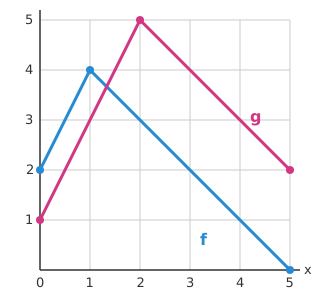
Use the graphs of \(f\) and \(g\) to find:
- \(h'(1)\) if \(h(x) = f(g(x))\)
- \(k'(2)\) if \(k(x) = g(f(x))\)
Solution 5
From the graphs: \(g(1) = 3\text{,}\) \(g'(1) = 2\text{,}\) \(f'(3) = -1\text{,}\) and \(f(2) = 3\text{,}\) \(f'(2) = -1\text{,}\) \(g'(3) = -1\text{.}\)
\begin{equation*} h'(1) = f'(g(1))\cdot g'(1) = f'(3)\cdot 2 = (-1)(2) = -2 \end{equation*}\begin{equation*} k'(2) = g'(f(2))\cdot f'(2) = g'(3)\cdot(-1) = (-1)(-1) = 1 \end{equation*}
Question 6 — Cosine of a Root
Differentiate the following function.
Solution 6
Outer function \(\cos u\text{,}\) inner function \(u = x^{1/2}\text{:}\)
\begin{equation*} \dfrac{dy}{dx} = -\sin\left(\sqrt{x}\right)\cdot\dfrac{1}{2\sqrt{x}} = -\dfrac{\sin\left(\sqrt{x}\right)}{2\sqrt{x}} \end{equation*}
Question 7 — Working Backwards to f′
If
calculate \(f'(x)\text{.}\)
Solution 7
By the chain rule:
\begin{equation*} f'\left(2x^3\right)\cdot 6x^2 = 12x^8 \quad\Rightarrow\quad f'\left(2x^3\right) = 2x^6 \end{equation*}Let \(u = 2x^3\text{,}\) so \(x^3 = \frac{u}{2}\) and \(x^6 = \frac{u^2}{4}\text{:}\)
\begin{equation*} f'(u) = 2\cdot\dfrac{u^2}{4} = \dfrac{u^2}{2} \quad\Rightarrow\quad f'(x) = \dfrac{x^2}{2} \end{equation*}
Question 8 — Exponential with a Constant
Differentiate the following function, where \(k\) is a constant.
Solution 8
Inner function \(u = -kx^2\text{,}\) so \(u' = -2kx\text{:}\)
\begin{equation*} \dfrac{dy}{dx} = 3e^{-kx^2}\cdot(-2kx) = -6kx\,e^{-kx^2} \end{equation*}
Question 9 — Tangent Line
Find the equation of the tangent line to
at \(x = 4\text{.}\)
Solution 9
Point: \(y(4) = \sqrt{25} = 5\text{.}\)
\begin{equation*} y' = \dfrac{1}{2\sqrt{x^2 + 9}}\cdot 2x = \dfrac{x}{\sqrt{x^2 + 9}} \quad\Rightarrow\quad m = \dfrac{4}{5} \end{equation*}\begin{equation*} y - 5 = \dfrac{4}{5}(x - 4) \quad\Rightarrow\quad y = \dfrac{4}{5}x + \dfrac{9}{5} \end{equation*}
Question 10 — Product with an Exponential
Differentiate the following function.
Solution 10
Product rule, with the chain rule on \(e^{\cos x}\text{:}\)
\begin{equation*} \dfrac{dy}{dx} = \cos x\cdot e^{\cos x} + \sin x\cdot e^{\cos x}(-\sin x) \end{equation*}\begin{equation*} \dfrac{dy}{dx} = e^{\cos x}\left(\cos x - \sin^2 x\right) \end{equation*}
Question 11 — Look for an Identity
Differentiate the following function.
Solution 11
Use \(1 - \sin^2 x = \cos^2 x\text{:}\)
\begin{equation*} y = \sqrt{\cos^2 x} = \left|\cos x\right| \end{equation*}Where \(\cos x \gt 0\text{:}\) \(y = \cos x\text{,}\) so \(y' = -\sin x\text{.}\)
Where \(\cos x \lt 0\text{:}\) \(y = -\cos x\text{,}\) so \(y' = \sin x\text{.}\)