Week 6 — Review Questions
Logarithms, inverse trig, and implicit differentiation
Question 1 — Chain Rule with ln
Differentiate the following function.
Solution 1
Use \(\frac{d}{dt}[\ln u] = \frac{u'}{u}\text{:}\)
\begin{equation*} f'(t) = \dfrac{7t^6}{t^7 + 7} \end{equation*}
Question 2 — Sine of a Logarithm
Differentiate the following function.
Solution 2
Chain rule, with \(\frac{d}{dt}[\ln t] = \frac{1}{t}\text{:}\)
\begin{equation*} g'(t) = \cos(\ln t)\cdot\dfrac{1}{t} = \dfrac{\cos(\ln t)}{t} \end{equation*}
Question 3 — Product Rule with ln
Differentiate the following function.
Solution 3
Product rule on the first term; \(\ln 7\) and \(\pi\) are constants:
\begin{equation*} \dfrac{dy}{dx} = 2\left(\ln x + \ln 7\right) + 2x\cdot\dfrac{1}{x} - 5 \end{equation*}\begin{equation*} \dfrac{dy}{dx} = 2\ln x + 2\ln 7 - 3 \end{equation*}
Question 4 — Inverse Sine
Differentiate the following function.
Solution 4
Use \(\frac{d}{dx}[\sin^{-1} u] = \frac{u'}{\sqrt{1-u^2}}\) with \(u = x^4\text{:}\)
\begin{equation*} f'(x) = 3\cdot\dfrac{4x^3}{\sqrt{1 - x^8}} = \dfrac{12x^3}{\sqrt{1 - x^8}} \end{equation*}
Question 5 — Product Rule with Inverse Tangent
Differentiate the following function.
Solution 5
Product rule, with \(\frac{d}{dx}[\arctan u] = \frac{u'}{1+u^2}\) and \(u = 5x^4\text{:}\)
\begin{equation*} f'(x) = 36x^3\arctan\left(5x^4\right) + 9x^4\cdot\dfrac{20x^3}{1 + 25x^8} \end{equation*}\begin{equation*} f'(x) = 36x^3\arctan\left(5x^4\right) + \dfrac{180x^7}{1 + 25x^8} \end{equation*}
Question 6 — Cosine Times Inverse Sine
Differentiate the following function.
Solution 6
Product rule:
\begin{equation*} f'(x) = -4\sin(x)\sin^{-1}(x) + \dfrac{4\cos(x)}{\sqrt{1 - x^2}} \end{equation*}
Question 7 — Simplify First
Differentiate the following function.
Solution 7
Use log rules to simplify before differentiating:
\begin{equation*} y = 3\ln x + 2\ln x + 2\ln x - \ln 3 - 7\ln x = -\ln 3 = \ln\left(\tfrac{1}{3}\right) \end{equation*}\(y\) is a constant, so
\begin{equation*} \dfrac{dy}{dx} = 0 \end{equation*}
Question 8 — Implicit Differentiation
Find \(\dfrac{dy}{dx}\) in terms of \(x\) and \(y\text{.}\)
Solution 8
Differentiate both sides with respect to \(x\text{:}\)
\begin{equation*} 4x^3y + x^4\dfrac{dy}{dx} - 1 - 9\dfrac{dy}{dx} = 0 \end{equation*}\begin{equation*} \dfrac{dy}{dx}\left(x^4 - 9\right) = 1 - 4x^3y \quad\Rightarrow\quad \dfrac{dy}{dx} = \dfrac{1 - 4x^3y}{x^4 - 9} \end{equation*}
Question 9 — Slope on an Implicit Curve
Find the slope of the tangent to the curve
at the point \((1, 5)\text{.}\)
Solution 9
\begin{equation*} 3x^2 + 3y + 3x\dfrac{dy}{dx} + 2y\dfrac{dy}{dx} = 0 \quad\Rightarrow\quad \dfrac{dy}{dx} = -\dfrac{3x^2 + 3y}{3x + 2y} \end{equation*}At \((1, 5)\text{:}\)
\begin{equation*} \dfrac{dy}{dx} = -\dfrac{3 + 15}{3 + 10} = -\dfrac{18}{13} \end{equation*}
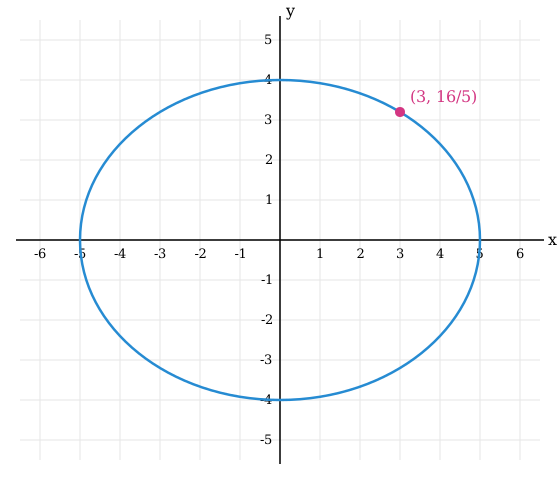
Question 10 — Tangent Line to an Ellipse
Find the equation of the tangent line to the ellipse
Solution 10
\begin{equation*} \dfrac{2x}{25} + \dfrac{2y}{16}\dfrac{dy}{dx} = 0 \quad\Rightarrow\quad \dfrac{dy}{dx} = -\dfrac{16x}{25y} \end{equation*}At \(\left(3, \tfrac{16}{5}\right)\text{:}\) \(m = -\dfrac{48}{80} = -\dfrac{3}{5}\)
\begin{equation*} y - \dfrac{16}{5} = -\dfrac{3}{5}(x - 3) \quad\Rightarrow\quad y = -\dfrac{3}{5}x + 5 \end{equation*}