Week 8 — Review Questions
Critical values
Question 1
Find all critical values of \(f(x) = 7x^3 - 21x + 5\text{.}\)
Solution 1
\begin{equation*} f'(x) = 21x^2 - 21 = 21(x-1)(x+1) \end{equation*}Setting \(f'(x) = 0\) gives critical values \(x = -1, 1\text{.}\)
Question 2
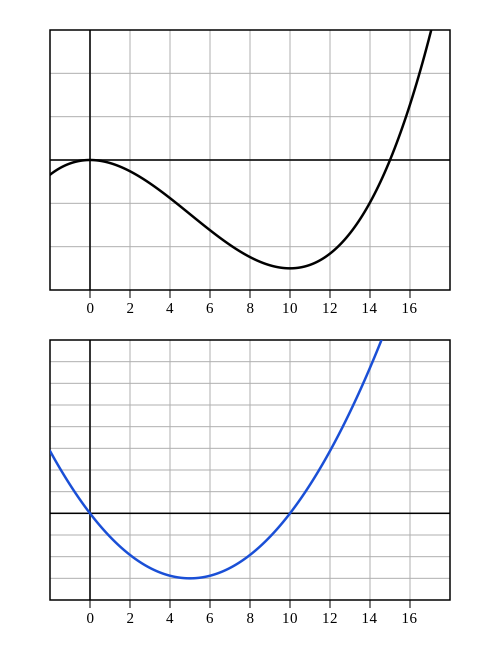
The graphs show \(f\) (black, top) and \(f'\) (blue, bottom) for \(f(x) = x^2(x - 15)\text{.}\) So \(f\) is decreasing (and \(f'\) is negative) on \((0, a)\text{.}\) Find the largest \(a\) that works.
Solution 2
\begin{equation*} f(x) = x^3 - 15x^2 \quad\Rightarrow\quad f'(x) = 3x^2 - 30x = 3x(x - 10) \end{equation*}\(f'(x) \lt 0\) between its zeros, on \((0, 10)\text{.}\) So \(a = 10\text{.}\)
Question 3
Find all critical points of \(f(x) = x^3 + 7x^2 - 4x - 1\text{.}\) List them in descending order.
Solution 3
\begin{equation*} f'(x) = 3x^2 + 14x - 4 = 0 \end{equation*}\begin{equation*} x = \frac{-14 \pm \sqrt{196 + 48}}{6} = \frac{-14 \pm 2\sqrt{61}}{6} = \frac{-7 \pm \sqrt{61}}{3} \end{equation*}Descending: \(x = \frac{-7 + \sqrt{61}}{3} \approx 0.270, \ \frac{-7 - \sqrt{61}}{3} \approx -4.937\)
Question 4
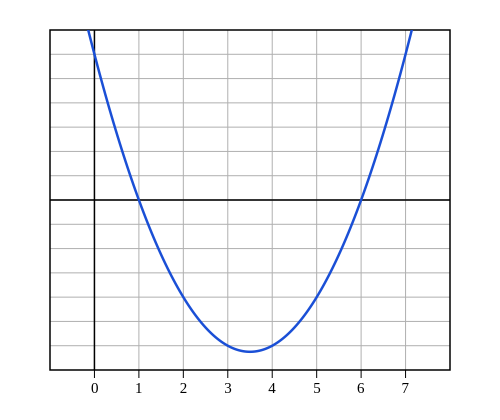
The graph shown is the graph of the derivative \(f'\) on \(0 \lt x \lt 7\text{.}\) Determine the intervals on which \(f\) is increasing or decreasing.
Solution 4
Read the sign of \(f'\) from the graph. It crosses zero at \(x = 1\) and \(x = 6\text{.}\)
On \((0, 1)\text{:}\) \(f' \gt 0\text{,}\) so \(f\) is increasing.
On \((1, 6)\text{:}\) \(f' \lt 0\text{,}\) so \(f\) is decreasing.
On \((6, 7)\text{:}\) \(f' \gt 0\text{,}\) so \(f\) is increasing.
Question 5
The function \(f(x) = -2x^3 + 39x^2 - 216x + 6\) has one local minimum and one local maximum. Find the \(x\)-value and function value of each.
Solution 5
\begin{equation*} f'(x) = -6x^2 + 78x - 216 = -6(x - 4)(x - 9) \end{equation*}\(f'' (x) = -12x + 78\text{:}\) \(f''(4) = 30 \gt 0\) (min), \(f''(9) = -30 \lt 0\) (max).
\begin{equation*} f(4) = -128 + 624 - 864 + 6 = -362 \end{equation*}\begin{equation*} f(9) = -1458 + 3159 - 1944 + 6 = -237 \end{equation*}Local min at \(x = 4\) with value \(-362\text{;}\) local max at \(x = 9\) with value \(-237\text{.}\)
Question 6
For \(f(x) = 3x + \sin x\text{,}\) find all intervals where \(f\) is increasing, all intervals where it is decreasing, and all critical points.
Solution 6
\begin{equation*} f'(x) = 3 + \cos x \end{equation*}Since \(-1 \le \cos x \le 1\text{,}\) we have \(f'(x) \ge 2 \gt 0\) for all \(x\text{.}\)
Increasing on \((-\infty, \infty)\text{.}\) Decreasing: none. Critical points: none.
Question 7
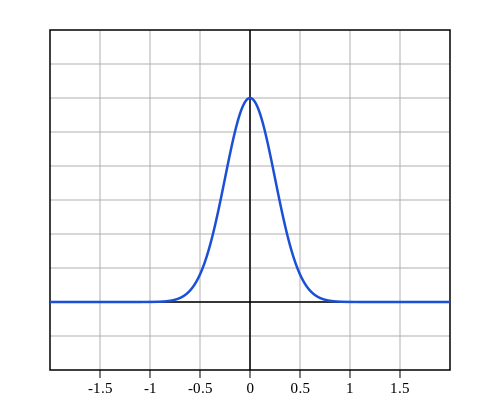
Use the graph of \(f(x) = 3e^{-8x^2}\) to estimate the \(x\)-values of any critical points and inflection points. Then use derivatives to find them exactly.
Solution 7
Estimate from the graph: critical point near \(x = 0\text{,}\) inflection points near \(x = \pm 0.25\text{.}\)
\begin{equation*} f'(x) = -48x\,e^{-8x^2} = 0 \quad\Rightarrow\quad x = 0 \end{equation*}\begin{equation*} f''(x) = -48e^{-8x^2} + 768x^2 e^{-8x^2} = 48e^{-8x^2}\left(16x^2 - 1\right) \end{equation*}\(f''(x) = 0\) when \(x^2 = \frac{1}{16}\text{,}\) so inflection points at \(x = \pm\frac{1}{4}\text{.}\)
Question 8
Find the inflection points of \(f(x) = 4x^4 + 54x^3 - 42x^2 + 9\text{.}\)
Solution 8
\begin{equation*} f'(x) = 16x^3 + 162x^2 - 84x \end{equation*}\begin{equation*} f''(x) = 48x^2 + 324x - 84 = 12\left(4x^2 + 27x - 7\right) = 12(4x - 1)(x + 7) \end{equation*}\(f''\) changes sign at each zero, so the inflection points are at \(x = -7, \frac{1}{4}\text{.}\)
Question 9
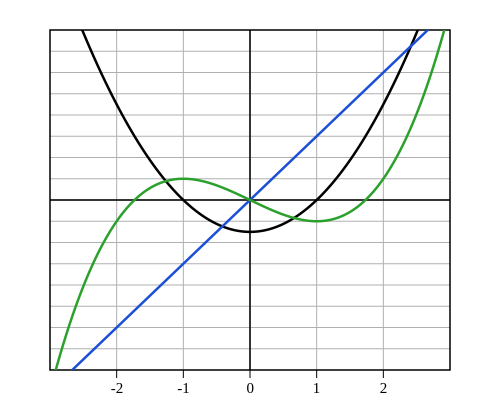
The graph shows three functions: A (black), B (blue), and C (green). If these are \(f\text{,}\) \(f'\text{,}\) and \(f''\text{,}\) identify which is which.
Solution 9
C (green) has a local max and min near \(x = \pm 1\text{,}\) exactly where A (black) crosses zero. So A is the derivative of C.
A (black) has its minimum at \(x = 0\text{,}\) exactly where B (blue) crosses zero. So B is the derivative of A.
\(f = \) C, \(f' = \) A, \(f'' = \) B
Question 10
Let \(f(x) = 2x - 2\ln(9x)\text{,}\) \(x \gt 0\text{.}\) Find the critical point, the intervals where \(f\) is increasing or decreasing, and apply the First Derivative Test.
Solution 10
\begin{equation*} f'(x) = 2 - \frac{2}{x} = 0 \quad\Rightarrow\quad x = 1 \end{equation*}On \((0, 1)\text{:}\) \(f' \lt 0\text{,}\) so \(f\) is decreasing.
On \((1, \infty)\text{:}\) \(f' \gt 0\text{,}\) so \(f\) is increasing.
\(f'\) changes from negative to positive, so \(f\) has a minimum at \(x = 1\text{.}\)