Week 8 — Review Questions (Round 2)
Critical values
Question 1
A particle moves along a line with position, in meters,
where \(t\) is in seconds. Find the time and position where the particle switches from accelerating to decelerating.
Solution 1
\begin{equation*} v(t) = s'(t) = -3t^2 + 18t \end{equation*}\begin{equation*} a(t) = s''(t) = -6t + 18 = 0 \quad\Rightarrow\quad t = 3 \end{equation*}For \(t \lt 3\text{,}\) \(a(t) \gt 0\text{.}\) For \(t \gt 3\text{,}\) \(a(t) \lt 0\text{.}\)
\begin{equation*} s(3) = -27 + 81 + 5 = 59 \end{equation*}The switch happens at \(t = 3\) seconds, at position \(59\) meters.
Question 2
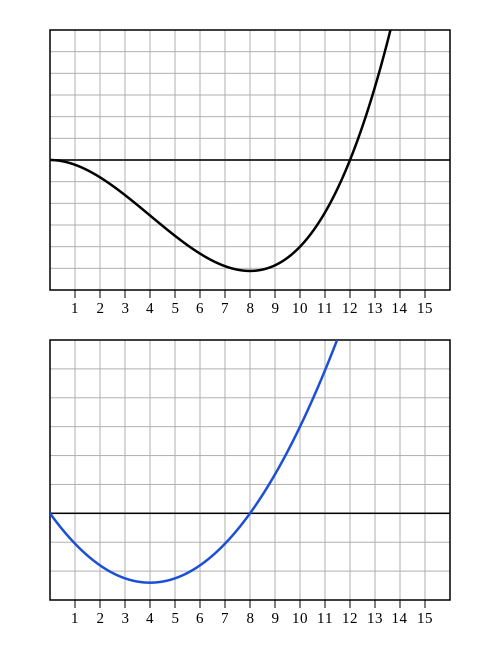
The graphs show the change in a stock’s value, in dollars, over \(t\) weeks (black, top),
and its rate \(V'(t)\) (blue, bottom). Find the largest \(a\) so the value is decreasing on \((0, a)\text{.}\)
Solution 2
\begin{equation*} V(t) = t^3 - 12t^2 \quad\Rightarrow\quad V'(t) = 3t^2 - 24t = 3t(t - 8) \end{equation*}\(V'(t) \lt 0\) on \((0, 8)\text{.}\) So \(a = 8\) weeks.
Question 3
A bacteria population, in thousands, after \(t\) hours is
When does the population peak?
Solution 3
\begin{equation*} P'(t) = -3t^2 + 8t + 6 = 0 \quad\Rightarrow\quad 3t^2 - 8t - 6 = 0 \end{equation*}\begin{equation*} t = \frac{8 \pm \sqrt{64 + 72}}{6} = \frac{8 \pm 2\sqrt{34}}{6} = \frac{4 \pm \sqrt{34}}{3} \end{equation*}Only the positive value makes sense: \(t = \frac{4 + \sqrt{34}}{3} \approx 3.28\text{.}\)
\(P' \gt 0\) before and \(P' \lt 0\) after, so the population peaks at about \(3.28\) hours.
Question 4
The volume of water in a tank, in gallons, after \(t\) minutes is
When does the volume switch from increasing to decreasing?
Solution 4
\begin{equation*} V'(t) = -6t^2 + 42t - 60 = -6(t - 2)(t - 5) \end{equation*}On \((2, 5)\text{:}\) \(V' \gt 0\text{,}\) so the volume is increasing.
On \((5, 7)\text{:}\) \(V' \lt 0\text{,}\) so the volume is decreasing.
The volume switches from increasing to decreasing at \(t = 5\) minutes.
Question 5
An object on a track is driven by a rotating arm. Its position, in meters, is
where \(\theta\) is the arm’s angle. Find the angles where the object momentarily stops.
Solution 5
\begin{equation*} x'(\theta) = 2 - 2\sqrt{2}\cos\theta = 0 \end{equation*}\begin{equation*} \cos\theta = \frac{1}{\sqrt{2}} \end{equation*}On \(-\frac{\pi}{2} \lt \theta \lt \frac{\pi}{2}\text{,}\) the object stops at \(\theta = \pm\frac{\pi}{4}\text{.}\)
Question 6
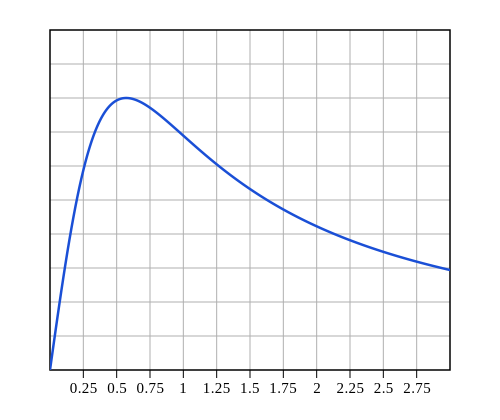
The concentration of a drug in the bloodstream, in mg/L, \(t\) hours after an injection is
Use the graph to estimate when the concentration is highest, then find it exactly.
Solution 6
Estimate from the graph: the peak is a little past \(t = 0.5\text{.}\)
\begin{equation*} C'(t) = \frac{112(49t^2 + 16) - 112t(98t)}{(49t^2 + 16)^2} = \frac{112(16 - 49t^2)}{(49t^2 + 16)^2} \end{equation*}\(C'(t) = 0\) when \(t^2 = \frac{16}{49}\text{,}\) so \(t = \frac{4}{7}\) hour.
\begin{equation*} C\left(\tfrac{4}{7}\right) = \frac{64}{16 + 16} = 2 \text{ mg/L} \end{equation*}
Question 7
Revenue, in thousands of dollars, is
where \(x\) is advertising spending in thousands of dollars. Find the point of diminishing returns, where revenue stops increasing at a faster rate and starts increasing at a slower rate.
Solution 7
\begin{equation*} R'(x) = -3x^2 + 18x + 15 \end{equation*}\begin{equation*} R''(x) = -6x + 18 = 0 \quad\Rightarrow\quad x = 3 \end{equation*}For \(x \lt 3\text{,}\) \(R'' \gt 0\text{.}\) For \(x \gt 3\text{,}\) \(R'' \lt 0\text{.}\)
\begin{equation*} R(3) = -27 + 81 + 45 + 100 = 199 \end{equation*}The point of diminishing returns is \((3, 199)\text{.}\)
Question 8
The average cost per item, in dollars, is
where \(x\) is thousands of items. How many items should you produce to minimize the average cost?
Solution 8
\begin{equation*} A'(x) = 4 - \frac{8}{x} = 0 \quad\Rightarrow\quad x = 2 \end{equation*}On \((0, 2)\text{:}\) \(A' \lt 0\text{.}\) On \((2, \infty)\text{:}\) \(A' \gt 0\text{.}\) So \(x = 2\) is a minimum.
Produce \(2{,}000\) items.
Question 9
The profit, in thousands of dollars, from producing \(x\) hundred units is
Find the local minimum and local maximum (\(x\) and value).
Solution 9
\begin{equation*} P'(x) = -6x^2 + 54x - 84 = -6(x - 2)(x - 7) \end{equation*}\(P''(x) = -12x + 54\text{:}\) \(P''(2) = 30 \gt 0\) (min), \(P''(7) = -30 \lt 0\) (max).
\begin{equation*} P(2) = -16 + 108 - 168 + 5 = -71 \end{equation*}\begin{equation*} P(7) = -686 + 1323 - 588 + 5 = 54 \end{equation*}Local min at \(x = 2\) with value \(-71\text{;}\) local max at \(x = 7\) with value \(54\text{.}\)