Week 9 (Round 2) — Review Questions
Global extrema, reading graphs of derivatives, and optimization word problems
Question 1 — Viewing a Painting
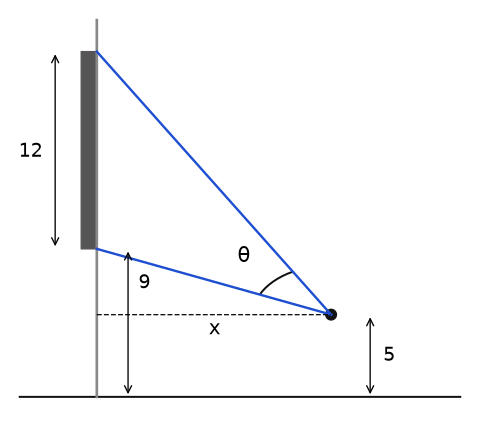
A painting 12 ft tall hangs on a wall with its bottom edge 9 ft above the floor. A visitor whose eye level is 5 ft above the floor stands \(x\) ft from the wall.
- Express the viewing angle \(\theta\) in terms of \(x\text{.}\)
- Find the distance \(x_0\) that maximizes \(\theta\text{.}\)
Solution 1
Top is \(21 - 5 = 16\) ft above eye level; bottom is \(9 - 5 = 4\) ft.
\begin{equation*} \theta(x) = \tan^{-1}\left(\frac{16}{x}\right) - \tan^{-1}\left(\frac{4}{x}\right) \end{equation*}\begin{equation*} \theta'(x) = -\frac{16}{x^2 + 256} + \frac{4}{x^2 + 16} = 0 \end{equation*}\begin{equation*} 4(x^2 + 256) = 16(x^2 + 16) \;\Rightarrow\; 12x^2 = 768 \;\Rightarrow\; x^2 = 64 \end{equation*}\begin{equation*} x_0 = 8 \text{ ft} \end{equation*}
Question 2 — Ladder Around a Corner
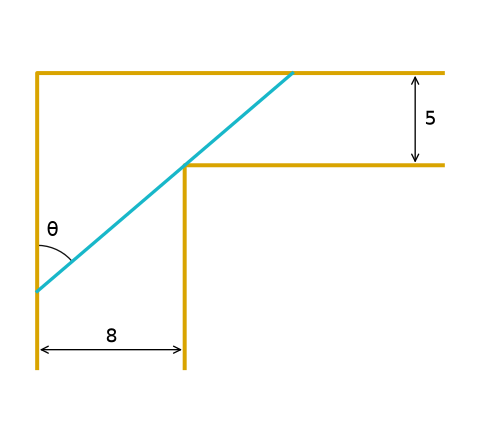
Movers carry a ladder horizontally down a hallway 8 ft wide. At the end there is a right-angled turn into a hallway 5 ft wide. What is the length of the longest ladder that can be carried around the corner?
Solution 2
The ladder touching the corner has length
\begin{equation*} L(\theta) = \frac{8}{\sin\theta} + \frac{5}{\cos\theta} \end{equation*}\begin{equation*} L'(\theta) = -\frac{8\cos\theta}{\sin^2\theta} + \frac{5\sin\theta}{\cos^2\theta} = 0 \;\Rightarrow\; \tan^3\theta = \frac{8}{5} \end{equation*}The longest ladder that fits is the minimum of \(L\text{:}\)
\begin{equation*} L_{\min} = \left(8^{2/3} + 5^{2/3}\right)^{3/2} \approx 18.22 \text{ ft} \end{equation*}
Question 3 — Water Main
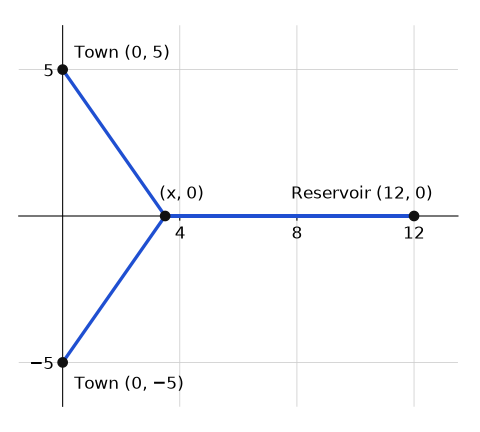
A water main runs from a reservoir at \((12, 0)\) to a junction \((x, 0)\text{,}\) then splits into two branches going to towns at \((0, 5)\) and \((0, -5)\text{.}\) Distances are in km. What is the minimum length of pipe?
Solution 3
\begin{equation*} f(x) = (12 - x) + 2\sqrt{x^2 + 25} \end{equation*}\begin{equation*} f'(x) = -1 + \frac{2x}{\sqrt{x^2 + 25}} = 0 \;\Rightarrow\; 4x^2 = x^2 + 25 \;\Rightarrow\; x = \frac{5}{\sqrt{3}} \approx 2.89 \end{equation*}\begin{equation*} f''(x) = \frac{50}{(x^2 + 25)^{3/2}} \;\Rightarrow\; f''\left(\tfrac{5}{\sqrt{3}}\right) = \frac{3\sqrt{3}}{20} \approx 0.26 \gt 0 \end{equation*}\begin{equation*} f\left(\tfrac{5}{\sqrt{3}}\right) = 12 - \frac{5}{\sqrt{3}} + \frac{20}{\sqrt{3}} = 12 + 5\sqrt{3} \approx 20.66 \text{ km} \end{equation*}
Question 4 — Filling a Tank
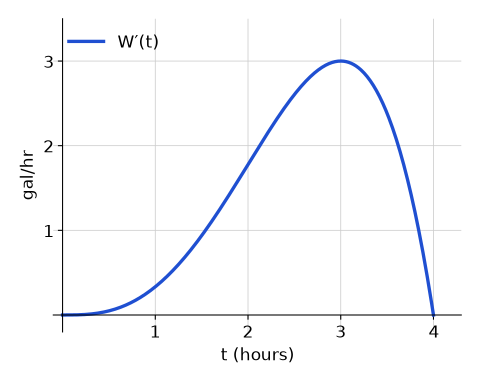
The graph shows the rate \(W'(t)\text{,}\) in gal/hr, at which water flows into a tank for \(0 \le t \le 4\) hours, where \(W(t)\) is the amount of water in the tank.
- Where does \(W\) have an inflection point?
- When is the amount of water greatest and least on \([0, 4]\text{?}\)
- If \(W(0) = 10\text{,}\) what are possible values for \(W(2)\text{?}\)
- How does \(W(4)\) compare to \(W(2)\text{?}\)
Solution 4
Inflection point at \(t = 3\text{:}\) \(W'\) changes from increasing to decreasing, so \(W''\) changes sign.
\(W' \ge 0\) on \([0, 4]\text{,}\) so \(W\) is increasing: least at \(t = 0\text{,}\) greatest at \(t = 4\text{.}\)
On \((0, 2)\text{,}\) \(0 \lt W'(t) \lt 3\text{,}\) so
\begin{equation*} 0 \lt W(2) - W(0) \lt 3\cdot 2 \;\Rightarrow\; W(2) \in (10, 16) \end{equation*}Since \(W\) is increasing, \(W(4) \gt W(2)\text{.}\)
Question 5 — Trail Elevation
The elevation, in meters relative to a trail marker, of a hiking trail at horizontal position \(x\) km is
- Where is the highest point of the trail, and what is its elevation?
- Where is the lowest point of the trail, and what is its elevation?
Solution 5
\begin{equation*} h'(x) = 2x^{-1/3} - 2 = \frac{2}{\sqrt[3]{x}} - 2 \end{equation*}Critical points: \(h'(x) = 0\) at \(x = 1\text{,}\) and \(h'\) is undefined at \(x = 0\text{.}\) Check the critical points and endpoints:
\begin{equation*} h(-8) = 12 + 16 = 28, \quad h(0) = 0, \quad h(1) = 1, \quad h(8) = 12 - 16 = -4 \end{equation*}Highest point at \(x = -8\) (28 m); lowest point at \(x = 8\) (−4 m).
Question 6 — Force on a Bead
The force, in newtons, on a small charged bead located \(x\) cm from the center of a ring (on either side) is
where \(x\) can be any real number. Find the exact global maximum and minimum force, and where they occur.
Solution 6
\begin{equation*} F'(x) = \frac{8(16 + x^2) - 8x(2x)}{(16 + x^2)^2} = \frac{8(16 - x^2)}{(16 + x^2)^2} \end{equation*}\(F'(x) = 0\) at \(x = \pm 4\text{.}\) Since \(F(x) \to 0\) as \(x \to \pm\infty\text{:}\)
\begin{equation*} F(4) = \frac{32}{32} = 1, \quad F(-4) = -1 \end{equation*}Global maximum 1 N at \(x = 4\text{;}\) global minimum −1 N at \(x = -4\text{.}\)
Question 7 — Solar Cell Efficiency
The efficiency of a solar cell is proportional to
where \(x\) is the ratio of the cell’s thickness to the coating’s thickness. What value of \(x\) gives the maximum efficiency?
Solution 7
Write \(E = k\,\dfrac{\ln x}{x^2}\) with \(k \gt 0\text{.}\)
\begin{equation*} E' = k\cdot\frac{\frac{1}{x}\cdot x^2 - 2x\ln x}{x^4} = k\cdot\frac{1 - 2\ln x}{x^3} \end{equation*}\(E' = 0\) when \(\ln x = \tfrac{1}{2}\text{.}\) \(E'\) changes from positive to negative there, so the maximum is at
\begin{equation*} x = e^{1/2} = \sqrt{e} \approx 1.649 \end{equation*}
Question 8 — Fertilizer and Yield
For some positive constant \(C\text{,}\) the increase in a crop’s yield from \(F\) units of fertilizer is
- What amount of fertilizer maximizes the yield increase?
- The sensitivity is \(dY/dF\text{.}\) What amount maximizes sensitivity?
Solution 8
\begin{equation*} Y = CF^2 - \frac{1}{2}F^3 \quad\Rightarrow\quad \frac{dY}{dF} = 2CF - \frac{3}{2}F^2 = F\left(2C - \frac{3}{2}F\right) \end{equation*}\(dY/dF = 0\) at \(F = \frac{4C}{3}\) (with \(F \gt 0\)), and \(Y'' = 2C - 3F = -2C \lt 0\) there, so \(Y\) is maximized at \(F = \frac{4C}{3}\text{.}\)
Sensitivity \(S = 2CF - \frac{3}{2}F^2\text{,}\) so \(S' = 2C - 3F = 0\) gives \(F = \frac{2C}{3}\text{,}\) and \(S'' = -3 \lt 0\text{.}\)
Sensitivity is maximized at \(F = \frac{2C}{3}\text{.}\)
Question 9 — Roller Coaster Track
The profile of a section of roller coaster track is
where \(a \gt 0\) is a constant the engineers can adjust.
- Find the local maximum and minimum of the track.
- As \(a\) increases, does each extremum move left, right, or not at all?
- As \(a\) increases, does each extremum move up, down, or not at all?
Solution 9
\begin{equation*} y' = 3x^2 - a = 0 \;\Rightarrow\; x = \pm\sqrt{\frac{a}{3}}, \qquad y'' = 6x \end{equation*}Local max at \(x = -\sqrt{\frac{a}{3}}\) (\(y'' \lt 0\)); local min at \(x = \sqrt{\frac{a}{3}}\) (\(y'' \gt 0\)).
\begin{equation*} y\left(\mp\sqrt{\tfrac{a}{3}}\right) = \pm\frac{2a}{3}\sqrt{\frac{a}{3}} \end{equation*}As \(a\) increases, both move away from \(x = 0\text{:}\) the max moves left and up; the min moves right and down.
Question 10 — Production Cost
The cost, in thousands of dollars, of producing \(x\) thousand items is
where \(a \gt 0\text{,}\) \(b \gt 1\text{,}\) and \(x \gt 1\text{.}\)
- Find \(C'(x)\text{.}\) Is \(C\) increasing or decreasing?
- Find \(C''(x)\text{.}\) Is \(C\) concave up or concave down?
Solution 10
\begin{equation*} C'(x) = a + 2\ln(bx) + 2x\cdot\frac{b}{bx} = a + 2 + 2\ln(bx) \end{equation*}For \(x \gt 1\) and \(b \gt 1\text{,}\) \(bx \gt 1\) so \(\ln(bx) \gt 0\text{.}\) With \(a \gt 0\text{,}\) \(C'(x) \gt 0\text{:}\) \(C\) is increasing.
\begin{equation*} C''(x) = \frac{2}{x} \end{equation*}For \(x \gt 1\text{,}\) \(C''(x) \gt 0\text{:}\) \(C\) is concave up.