Week 10 — Review Questions
Optimization and related rates
Question 1
Find two numbers \(A\) and \(B\) (with \(A \le B\)) whose difference is \(44\) and whose product is minimized.
Solution 1
Let \(B = A + 44\text{.}\) Then
\begin{equation*} P(A) = A(A + 44) = A^2 + 44A \end{equation*}\begin{equation*} P'(A) = 2A + 44 = 0 \;\Rightarrow\; A = -22 \end{equation*}\(P''(A) = 2 \gt 0\text{,}\) so this is a minimum: \(A = -22\text{,}\) \(B = 22\text{.}\)
Question 2
Oil spilled from a ruptured tanker spreads in a circle whose area increases at a constant rate of \(7\) mi\(^2\)/hr. How rapidly is the radius of the spill increasing when the area is \(11\) mi\(^2\text{?}\)
Solution 2
\begin{equation*} A = \pi r^2 \;\Rightarrow\; \frac{dA}{dt} = 2\pi r\frac{dr}{dt} \end{equation*}When \(A = 11\text{,}\) \(r = \sqrt{11/\pi} \approx 1.871\text{.}\)
\begin{equation*} \frac{dr}{dt} = \frac{7}{2\pi\sqrt{11/\pi}} \approx 0.595 \text{ mi/hr} \end{equation*}
Question 3
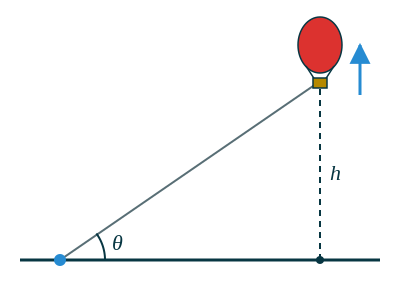
A hot air balloon rising vertically is tracked by an observer located \(2\) miles from the lift-off point. At a certain moment, the angle between the observer’s line-of-sight and the horizontal is \(\frac{\pi}{4}\text{,}\) and it is changing at a rate of \(0.1\) rad/min. How fast is the balloon rising at this moment?
Solution 3
Question 4
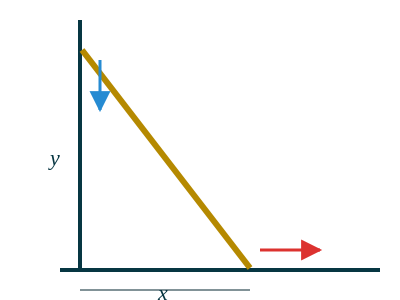
A \(17\) foot ladder is leaning against a wall. If the top slips down the wall at a rate of \(4\) ft/s, how fast will the foot be moving away from the wall when the top is \(16\) feet above the ground?
Solution 4
When \(y = 16\text{,}\) \(x = \sqrt{289 - 256} = \sqrt{33}\text{,}\) and \(\frac{dy}{dt} = -4\text{.}\)
Question 5
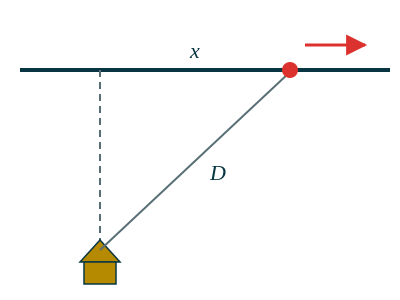
A road perpendicular to a highway leads to a farmhouse located \(9\) miles away. An automobile traveling on the highway passes through this intersection at a speed of \(70\) mph. How fast is the distance between the automobile and the farmhouse increasing when the automobile is \(6\) miles past the intersection?
Solution 5
When \(x = 6\text{,}\) \(D = \sqrt{117}\text{.}\)
Question 6
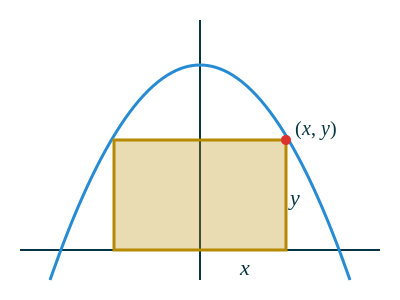
A rectangle is inscribed with its base on the \(x\)-axis and its upper corners on the parabola \(y = 1 - x^2\text{.}\) What are the dimensions of such a rectangle with the greatest possible area?
Solution 6
Width \(2x\text{,}\) height \(y = 1 - x^2\text{:}\)
Width \(= \frac{2}{\sqrt{3}} \approx 1.155\text{,}\) height \(= \frac{2}{3}\)
Question 7
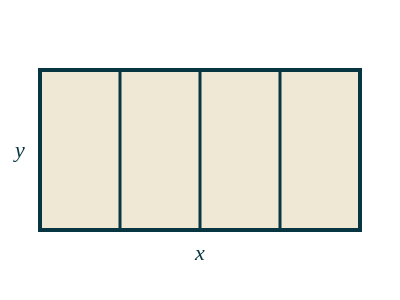
A rancher wants to enclose a rectangular area and then divide it into four pens with fencing parallel to one side of the rectangle. There are \(690\) feet of fencing available. What is the largest possible total area of the four pens?
Solution 7
\(x = 172.5\text{,}\) \(y = 69\)
Question 8
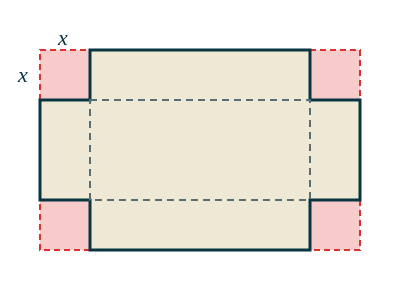
An open box is to be made out of an \(8\)-inch by \(14\)-inch piece of cardboard by cutting out squares of equal size from the four corners and bending up the sides. Find the dimensions of the resulting box that has the largest volume.
Solution 8
Bottom: \(4.722 \times 10.722\) in, height \(1.639\) in
Question 9
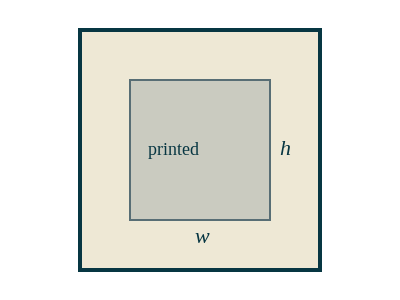
The top and bottom margins of a poster are \(6\) cm and the side margins are each \(7\) cm. If the area of printed material on the poster is fixed at \(388\) square centimeters, find the dimensions of the poster with the smallest area.
Solution 9
Poster: \(35.28\) cm wide, \(30.24\) cm tall
Question 10
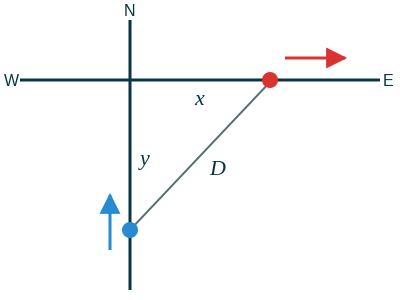
A police officer is \(1/2\) mile south of an intersection, driving north at \(40\) mph. Another car is \(1/2\) mile east of the intersection, driving east.
The radar reads \(25\) mph (distance increasing). What is the other car’s speed?
The radar reads \(-25\) mph (distance decreasing). What is the other car’s speed?
Solution 10
\(x = y = \frac{1}{2}\text{,}\) \(D = \frac{\sqrt{2}}{2}\text{,}\) \(\frac{dy}{dt} = -40\text{:}\)
(1) \(40 + 25\sqrt{2} \approx 75.36\) mph (2) \(40 - 25\sqrt{2} \approx 4.64\) mph