Week 11 — Review Questions
Riemann sums and the definite integral
Question 1
Evaluate the definite integral:
Solution 1
The region is a rectangle of width \(5 - 3 = 2\) and height \(5\text{.}\)
\begin{equation*} \int_3^5 5\,dx = 2 \cdot 5 = 10 \end{equation*}
Question 2
The velocity of a car is \(f(t) = 7t\) meters/second. Use a graph of \(f(t)\) to find the exact distance traveled by the car, in meters, from \(t = 0\) to \(t = 10\) seconds.
Solution 2
The region under \(f(t) = 7t\) on \([0, 10]\) is a triangle with base \(10\) and height \(f(10) = 70\text{.}\)
\begin{equation*} \text{distance} = \frac{1}{2}(10)(70) = 350 \text{ m} \end{equation*}
Question 3
The velocity of a particle moving along the \(x\)-axis is given by \(f(t) = 12 - 4t\) cm/sec. Use a graph of \(f(t)\) to find the exact change in position of the particle from time \(t = 0\) to \(t = 4\) seconds.
Solution 3
The velocity is zero at \(t = 3\text{.}\)
On \([0, 3]\text{:}\) triangle above the axis, area \(\frac{1}{2}(3)(12) = 18\text{.}\)
On \([3, 4]\text{:}\) triangle below the axis, area \(\frac{1}{2}(1)(4) = 2\text{.}\)
\begin{equation*} \text{change in position} = 18 - 2 = 16 \text{ cm} \end{equation*}
Question 4
The sum
can be written as a single integral in the form \(\int_a^b f(x)\,dx\text{.}\) Determine \(a\) and \(b\text{.}\)
Solution 4
\begin{equation*} \int_{-2}^{2} f\,dx + \int_{2}^{5} f\,dx = \int_{-2}^{5} f\,dx \end{equation*}\begin{equation*} \int_{-2}^{5} f\,dx - \int_{-2}^{-1} f\,dx = \int_{-1}^{5} f\,dx \end{equation*}\(a = -1\text{,}\) \(b = 5\)
Question 5
If
find \(\int_1^6 f(x)\,dx\text{.}\)
Solution 5
\begin{equation*} 3\int_1^6 f(x)\,dx + \int_1^6 8\,dx = 3 \end{equation*}\begin{equation*} 3\int_1^6 f(x)\,dx + 8(5) = 3 \;\Rightarrow\; 3\int_1^6 f(x)\,dx = -37 \end{equation*}\begin{equation*} \int_1^6 f(x)\,dx = -\frac{37}{3} \end{equation*}
Question 6
Evaluate the following integral by interpreting it in terms of areas:
Solution 6
The line crosses the \(x\)-axis at \(x = 2\text{.}\)
On \([0, 2]\text{:}\) triangle below the axis, area \(\frac{1}{2}(2)(1) = 1\text{.}\)
On \([2, 3]\text{:}\) triangle above the axis, area \(\frac{1}{2}(1)\left(\frac{1}{2}\right) = \frac{1}{4}\text{.}\)
\begin{equation*} \int_0^3 \left(\frac{1}{2}x - 1\right)dx = -1 + \frac{1}{4} = -\frac{3}{4} \end{equation*}
Question 7
Evaluate the following integral by interpreting it in terms of areas:
Solution 7
\begin{equation*} \int_{-3}^{0} 1\,dx = 3 \quad \text{(rectangle)} \end{equation*}\begin{equation*} \int_{-3}^{0} \sqrt{9 - x^2}\,dx = \frac{1}{4}\pi(3)^2 = \frac{9\pi}{4} \quad \text{(quarter circle)} \end{equation*}\begin{equation*} \int_{-3}^{0} \left(1 + \sqrt{9 - x^2}\right)dx = 3 + \frac{9\pi}{4} \approx 10.07 \end{equation*}
Question 8
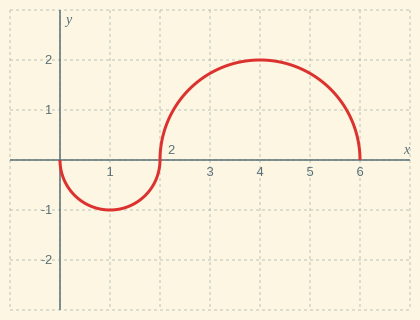
Evaluate the integrals for \(f(x)\) shown in the figure. The two parts of the graph are semicircles.
\(\displaystyle \int_0^2 5f(x)\,dx\)
\(\displaystyle \int_0^6 3f(x)\,dx\)
\(\displaystyle \int_1^4 4f(x)\,dx\)
\(\displaystyle \int_1^6 \left|3f(x)\right|dx\)
Solution 8
Small semicircle (below): area \(\frac{\pi}{2}\text{.}\) Large semicircle (above): area \(2\pi\text{.}\)
(1) \(5\left(-\frac{\pi}{2}\right) = -\frac{5\pi}{2}\)
(2) \(3\left(-\frac{\pi}{2} + 2\pi\right) = \frac{9\pi}{2}\)
(3) \(4\left(-\frac{\pi}{4} + \pi\right) = 3\pi\)
(4) \(3\left(\frac{\pi}{4} + 2\pi\right) = \frac{27\pi}{4}\)
Question 9
Suppose \(f(x) = \dfrac{16}{x}\text{.}\)
Find the left endpoint Riemann sum for \(f(x)\) on \(2 \le x \le 4\) with \(n = 4\text{.}\) Is it an overestimate or an underestimate of the area under \(y = f(x)\text{?}\)
Find the right endpoint Riemann sum for \(f(x)\) on \(2 \le x \le 4\) with \(n = 4\text{.}\) Is it an overestimate or an underestimate of the area under \(y = f(x)\text{?}\)
Solution 9
\(\Delta x = 0.5\text{,}\) points \(2, 2.5, 3, 3.5, 4\text{,}\) values \(8, 6.4, \frac{16}{3}, \frac{32}{7}, 4\text{.}\)
\begin{equation*} L_4 = 0.5\left(8 + 6.4 + \tfrac{16}{3} + \tfrac{32}{7}\right) \approx 12.15 \end{equation*}\begin{equation*} R_4 = 0.5\left(6.4 + \tfrac{16}{3} + \tfrac{32}{7} + 4\right) \approx 10.15 \end{equation*}\(f\) is decreasing, so \(L_4\) is an overestimate and \(R_4\) is an underestimate.
Question 10
Estimate how far an object traveled during \(0 \le t \le 8\) using this velocity data:
| time (sec) | 0 | 1 | 2 | 3 | 4 | 5 | 6 | 7 | 8 |
| velocity (ft/sec) | -4 | -1 | -2 | -3 | -2 | -1 | 2 | 4 | 1 |
Using a left endpoint Riemann sum, find the total displacement and the total distance traveled.
Using a right endpoint Riemann sum, find the total displacement and the total distance traveled.
Solution 10
Each interval has \(\Delta t = 1\text{.}\)
Left (\(t = 0\) to \(7\)):
\begin{equation*} \text{displacement} = -4 - 1 - 2 - 3 - 2 - 1 + 2 + 4 = -7 \text{ ft} \end{equation*}\begin{equation*} \text{distance} = 4 + 1 + 2 + 3 + 2 + 1 + 2 + 4 = 19 \text{ ft} \end{equation*}Right (\(t = 1\) to \(8\)):
\begin{equation*} \text{displacement} = -1 - 2 - 3 - 2 - 1 + 2 + 4 + 1 = -2 \text{ ft} \end{equation*}\begin{equation*} \text{distance} = 1 + 2 + 3 + 2 + 1 + 2 + 4 + 1 = 16 \text{ ft} \end{equation*}